
William McKinley facts for kids
Quick facts for kids
William McKinley
|
|
|---|---|
.jpg)
McKinley c. 1900
|
|
| 25th President of the United States | |
| In office March 4, 1897 – September 14, 1901 |
|
| Preceded by | Grover Cleveland |
| Succeeded by | Theodore Roosevelt |
| 39th Governor of Ohio | |
| In office January 11, 1892 – January 13, 1896 |
|
| Lieutenant | Andrew L. Harris |
| Preceded by | James E. Campbell |
| Succeeded by | Asa S. Bushnell |
| Member of the U.S. House of Representatives from Ohio |
|
| In office March 4, 1885 – March 3, 1891 |
|
| Preceded by | David R. Paige |
| Succeeded by | Joseph D. Taylor |
| Constituency |
|
| In office March 4, 1877 – May 27, 1884 |
|
| Preceded by | Laurin D. Woodworth |
| Succeeded by | Jonathan H. Wallace |
| Constituency |
|
| Personal details | |
| Born |
William McKinley Jr.
January 29, 1843 Niles, Ohio, U.S. |
| Died | September 14, 1901 (aged 58) Buffalo, New York, U.S. |
| Cause of death | Assassination (gangrene due to infection in gunshot wound) |
| Resting place | McKinley National Memorial |
| Political party | Republican |
| Spouse | |
| Children | 2 |
| Parents |
|
| Education |
|
| Profession |
|
| Signature |  |
| Military service | |
| Branch/service | United States Army (Union Army) |
| Rank | Brevet major |
| Unit | 23rd Ohio Infantry |
| Battles/wars | |
|
Other offices
1889–1891: Chair of the House Ways and Means Committee
|
|
William McKinley (born January 29, 1843, died September 14, 1901) was the 25th President of the United States. He served from 1897 until he was assassinated in 1901. As a member of the Republican Party, he helped make his party very strong across the country for many years. McKinley successfully led the U.S. during the Spanish–American War. He also oversaw a time when America expanded its territories, adding places like Hawaii, Puerto Rico, Guam, the Philippines, and American Samoa.
McKinley was the last president who fought in the American Civil War. He started as a regular soldier and rose to the rank of major. After the war, he became a lawyer in Canton, Ohio, and married Ida Saxton. In 1876, he was elected to Congress. There, he became known for supporting "protective tariffs." These were taxes on imported goods, which he believed would help American businesses and workers. His 1890 tariff law was debated a lot. He lost his re-election in 1890 partly because of this and changes to his voting district. Later, he was elected Governor of Ohio twice, from 1891 to 1896. He tried to be fair to both business owners and workers.
In 1896, during a tough economic time, McKinley became the Republican candidate for president. He won against his Democratic opponent, William Jennings Bryan, by campaigning from his home. He promised to bring back good times with strong tariffs and by keeping the country on the "gold standard" (meaning the value of money was tied to gold). As president, the U.S. economy grew quickly. He signed the Dingley Tariff in 1897 to protect American businesses and passed the Gold Standard Act in 1900.
McKinley's foreign policy involved expanding America's influence around the world, similar to other powerful nations. The U.S. took over the independent Republic of Hawaii in 1898, making it a U.S. territory in 1900. McKinley tried to convince Spain to let Cuba be free. When talks failed, he asked Congress to declare war, starting the Spanish–American War in 1898. The U.S. won quickly. After the war, Spain gave Puerto Rico, Guam, and the Philippines to the U.S. Cuba became independent but stayed under American influence for a while. In the Philippines, a fight for independence began, which the U.S. eventually stopped. McKinley also gained American Samoa for the U.S. by making an agreement with Britain and Germany.
McKinley won re-election in 1900, again defeating William Jennings Bryan. This campaign focused on America's new territories, protecting American businesses, and money issues. His second term was cut short when he was shot on September 6, 1901, by Leon Czolgosz. McKinley died eight days later. Vice President Theodore Roosevelt then became president. Many historians see McKinley's 1896 election as a major turning point in American politics, leading to a long period where the Republican Party was very strong. The U.S. still controls most of the territories McKinley added, except for the Philippines, which became independent in 1946. Today, historians usually rank McKinley as a good, but not outstanding, president.
Contents
- William McKinley: America's 25th President
- Funeral, Memorials, and Legacy
- See also
William McKinley: America's 25th President
Early Life and Family

William McKinley Jr. was born in 1843 in Niles, Ohio. He was the seventh of nine children. His parents were William McKinley Sr. and Nancy McKinley. His family had English and Scots-Irish roots.
The family moved to Poland, Ohio, in 1852 so the children could go to better schools. William graduated from Poland Seminary in 1859. He then attended Allegheny College for a year. He had to return home due to illness and family money problems. He also studied at Mount Union College. To help his family, he worked as a postal clerk and later as a teacher.
A Young Soldier in the Civil War

When the American Civil War began in 1861, McKinley joined the Union Army as a private. He was part of the 23rd Ohio Infantry. He quickly adapted to army life. He wrote letters to his hometown newspaper, praising the army and the Union cause.
McKinley's regiment went to western Virginia (now West Virginia) in July 1861. They fought their first battle at Battle of Carnifex Ferry. Three days later, McKinley started working in the supply office. He helped get supplies for his regiment. In April 1862, he was promoted to sergeant.
In September 1862, McKinley's regiment joined the main Union army. They fought in the Battle of South Mountain and the Battle of Antietam. Antietam was one of the bloodiest battles of the war. McKinley showed bravery, even bringing food to soldiers during heavy fighting. The Union army won, and the Confederates retreated.
Promotions and Key Battles

McKinley was sent back to Ohio to recruit new soldiers. While there, he was surprised with a promotion to second lieutenant for his bravery at Antietam. He saw more action in July 1863 at the Battle of Buffington Island.
In 1864, McKinley's unit moved to the Shenandoah Valley. They fought in several battles, including Battle of Cloyd's Mountain. McKinley later said this battle was very intense. He was promoted to captain after the Second Battle of Kernstown. He then joined General George Crook's staff.
McKinley continued to fight in the Shenandoah Valley campaigns. He helped rally troops at the Battle of Cedar Creek. After the war ended in 1865, McKinley received his final promotion to major. He decided not to stay in the army and returned to Ohio.
Legal Career and Family Life
After the war, McKinley decided to become a lawyer. He studied law in Ohio and New York. In March 1867, he became a lawyer in Warren, Ohio. He then moved to Canton, Ohio, and started his own law office.
His friend Rutherford B. Hayes ran for governor, and McKinley gave speeches for him, starting his own political journey. He was elected as a prosecuting attorney in his county, but lost his re-election.
In 1871, McKinley married Ida Saxton. They had two daughters, Katherine and Ida. Sadly, their second daughter, Ida, died the same year she was born. Two years later, Katherine died from typhoid fever. Ida became very sad and her health worsened. She developed epilepsy and relied greatly on her husband. McKinley was a very devoted husband, always caring for her needs.
In 1876, McKinley defended a group of striking coal miners for free. He helped most of them get acquitted. This case made him popular with workers and introduced him to Mark Hanna, who would become a key supporter. That same year, McKinley was elected to Congress.
Rising in Politics: Congressman and Governor

McKinley became a strong supporter of "protective tariffs" in Congress. These were taxes on goods imported from other countries. He believed these tariffs would help American businesses grow and create jobs. In 1889, he became chairman of an important committee in the House of Representatives. He helped pass the McKinley Tariff of 1890, which put taxes on many foreign goods.
Democrats tried to redraw voting districts to make it harder for McKinley to win elections. This is called "gerrymandering." Despite these efforts, McKinley often won. However, the 1890 McKinley Tariff was not popular with everyone. Combined with new district lines, it led to his defeat in the 1890 election.
Governor of Ohio
After leaving Congress, McKinley ran for Governor of Ohio in 1891 and won. Ohio was an important state in national politics. As governor, McKinley was fair to both business owners and workers. He helped create a board to settle work disputes. He also passed a law protecting workers who joined unions.
In 1892, McKinley was chosen to lead the Republican National Convention. This made him a well-known figure across the country. He was re-elected governor in 1893 with a large number of votes. During this time, the country faced a tough economic period. McKinley's popularity grew as people sympathized with him after he faced personal financial difficulties.
The Election of 1896

McKinley began preparing to run for president with the help of his friend, Mark Hanna. Hanna used his money and organizing skills to build support for McKinley. He worked hard to get delegates from different states to support McKinley.
By the time the Republican convention started in June 1896, McKinley had enough support to win the nomination. He stayed in Canton, Ohio, and heard the news by telephone. Thousands of supporters came to his home to celebrate. The convention chose Garret Hobart as his running mate for vice president.
The "Front Porch Campaign"

The main issues in the 1896 election were money and tariffs. The country was debating whether to base its money only on gold (the "gold standard") or on both gold and silver ("free silver"). McKinley supported the gold standard. His opponent, William Jennings Bryan, strongly supported free silver.
Bryan traveled across the country giving many speeches. McKinley decided to stay home in Canton, Ohio. He ran a "Front Porch Campaign." People came to visit him at his home, and he gave speeches from his porch. These speeches were carefully planned. This strategy was very successful.

Many newspapers supported McKinley. However, some, like the New York Journal, criticized him and Hanna. They showed Hanna as a powerful businessman controlling McKinley. Despite this, McKinley won the election on November 3, 1896. He won the Northeast and Midwest, getting 51% of the vote. This election was a major turning point in American politics, leading to a long period of Republican strength.
McKinley's Presidency (1897–1901)

McKinley became president on March 4, 1897. He spoke about the need for tariff reform and avoiding foreign wars. He chose his cabinet carefully. Theodore Roosevelt became Assistant Secretary of the Navy, even though McKinley worried he was too impulsive.
The Spanish-American War
For many years, people in Cuba had been fighting for independence from Spain. Americans felt sympathy for the Cuban rebels. McKinley wanted to solve the problem peacefully. He hoped Spain would grant Cuba independence.
In January 1898, the U.S. battleship USS Maine was sent to Havana, Cuba. On February 15, the Maine exploded, killing 266 sailors. Many Americans believed Spain was responsible. McKinley asked for an investigation. When the investigation suggested an underwater mine caused the explosion, pressure for war grew.
McKinley asked Congress to act. On April 20, Congress declared war on Spain. The Spanish–American War began. McKinley used new technologies like the telegraph to direct the army and navy. The U.S. Navy quickly won a major victory at the Battle of Manila Bay in the Philippines. This expanded the war's focus to Spain's Pacific colonies.
In Cuba, American troops landed near Santiago de Cuba. They fought in the Battle of San Juan Hill and won. Spain's navy was destroyed in the Battle of Santiago de Cuba. Santiago surrendered, giving the U.S. control of Cuba. The U.S. also invaded Puerto Rico with little resistance. Spain soon sought to end the war.
Peace and New Territories

McKinley's cabinet agreed that Spain must leave Cuba and Puerto Rico. There was debate about what to do with the Philippines. Many Americans wanted to keep the islands.
In December 1898, the Treaty of Paris was signed. The United States gained Puerto Rico, Guam, and the Philippines. Spain also gave up its claims to Cuba. The U.S. paid Spain $20 million. McKinley worked hard to get the Senate to approve the treaty, which it did in February 1899.
Annexing Hawaii
.jpg)
During the war, McKinley also pushed for the U.S. to take over the Republic of Hawaii. Hawaii's monarchy had been overthrown in 1893. The need for Pacific naval bases became clear during the war. McKinley believed it was America's "manifest destiny" to annex Hawaii. In July 1898, he signed a resolution making Hawaii a U.S. territory.
Expanding Influence in China
McKinley wanted to increase trade with China. He supported an "Open Door Policy." This policy meant all nations could trade freely with China, and no country should try to take over Chinese land.
In 1900, American missionaries and other foreigners in China were threatened by the Boxer Rebellion. McKinley sent 5,000 troops to Beijing to help. This action set a precedent for future presidents to use military force without Congress's direct approval. After the rebellion, the U.S. continued to support the Open Door Policy.
Tariffs and the Gold Standard

McKinley had always supported high tariffs. He believed they protected American businesses and workers. In 1897, he signed the Dingley Act, which raised tariffs on many goods.
The country also continued to debate its money system. After international efforts to use both gold and silver failed, McKinley fully supported the gold standard. As the economy improved and new gold was discovered, the debate over silver lessened. In March 1900, McKinley signed the Gold Standard Act, officially tying the U.S. dollar to gold.
Civil Rights
Many African Americans hoped McKinley's presidency would bring progress toward equality. McKinley had spoken against lynching as governor. However, his main goal was to unite the country after the Civil War. He made some appointments of African Americans to government jobs.
But his administration did little to stop racial violence. When black postmasters were attacked in the South, McKinley did not publicly condemn these acts. Many black leaders felt disappointed by his inaction. In 1898, he toured the South, promoting unity. He visited Booker T. Washington and Confederate memorials. However, he did not address racial tensions during his tour.
The Election of 1900

McKinley was very popular and easily won the Republican nomination for re-election in 1900. The main question was who would be his vice president. Garret Hobart had died in 1899. Many people wanted Theodore Roosevelt, who was then Governor of New York and a war hero.
McKinley was renominated unanimously. Roosevelt was chosen as his vice president. The Democrats again nominated William Jennings Bryan. The campaign focused on America's new territories, economic prosperity, and tariffs. Bryan traveled and spoke widely, but McKinley stayed home, giving only one speech. Roosevelt became the main speaker for the campaign.
On November 6, 1900, McKinley won re-election with a large victory. He won more states than any Republican president since 1872.
Second Term and Assassination
After his second inauguration in March 1901, McKinley and his wife, Ida, began a six-week tour of the country. They traveled by train through the South and West. However, Ida became ill in California, so McKinley limited his public events. He postponed a visit to the Pan-American Exposition in Buffalo, New York, until September.
The Shooting

McKinley enjoyed meeting people, but his secretary, George Cortelyou, worried about his safety. There had been recent attacks on leaders in Europe. McKinley refused to cancel a public reception at the exposition.
On September 6, 1901, McKinley was meeting the public at the Temple of Music. A man named Leon Czolgosz shot McKinley twice in the stomach. Czolgosz was an anarchist who believed his actions would help his cause.
McKinley was taken to an aid station. Doctors could not find one of the bullets. He was then taken to a nearby home. For several days, doctors thought McKinley was getting better. Vice President Roosevelt even left Buffalo for a camping trip.
_-_DPLA_-_12610d761dd44e93dc6fc18aa9d4c13a.jpg)
However, on September 13, McKinley's condition worsened. Doctors realized he was dying. An infection had spread in his body. McKinley knew he was dying and asked for prayer. He died at 2:15 a.m. on September 14, 1901.
Theodore Roosevelt rushed back to Buffalo and became president. Czolgosz was put on trial for murder, found guilty, and executed in October 1901.
Funeral, Memorials, and Legacy
Funeral and Resting Place
The nation felt great sadness at McKinley's death. His casket was first placed in the White House. Then it lay in state at the Capitol, where about 100,000 people came to pay their respects. It was then taken by train to Canton, Ohio.
Ida McKinley was too weak to attend the public services. She remained in Canton for the rest of her life. She often visited her husband's temporary resting place. She died in 1907, just months before the completion of the McKinley National Memorial in Canton. William and Ida McKinley are buried there with their daughters.
Other Memorials
Many memorials honor McKinley across the country. The William McKinley Monument stands in front of the Ohio Statehouse in Columbus. A large statue is at his birthplace in Niles, Ohio. Many schools are named after him.
In 1896, a gold prospector named Denali, North America's tallest mountain, after McKinley. The name was changed back to Denali in 1975. However, in 2025, the name was restored to Mount McKinley.
Legacy and Historical Image
Historians agree that McKinley died as a very loved president. However, the popular Theodore Roosevelt quickly took the spotlight. For many years, McKinley's presidency was seen as less important than Roosevelt's.
Starting in the 1950s, historians began to view McKinley more favorably. He is usually ranked in the middle among U.S. presidents. Some historians believe he should be ranked higher. They point to his success in uniting the Republican Party and leading the country during a time of great change.

McKinley's administration included many talented people who later became important leaders. These included George B. Cortelyou, Charles G. Dawes, William R. Day, and William Howard Taft. After his assassination, the United States Secret Service began protecting presidents.
A debated part of McKinley's presidency is the expansion of U.S. territories. The U.S. still controls most of the territories gained under McKinley, except for the Philippines, which became independent in 1946. Historians continue to discuss whether McKinley's actions were part of an "American empire."
McKinley was a conservative president. His administration focused on conservative policies in foreign affairs, civil rights, and the economy. He believed in limited government involvement in the economy. Today, scholars continue to study McKinley's important role in American history.
Gallery of Memorials
-
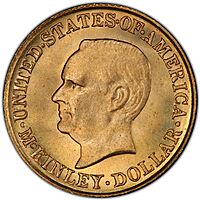
The McKinley Birthplace Memorial gold dollar was minted in 1916 and 1917.
-
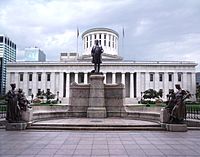
William McKinley Monument by Hermon MacNeil in front of the Ohio Statehouse, Columbus.
-
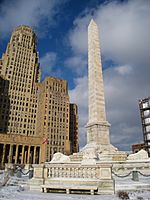
McKinley Monument by Alexander Phimister Proctor in front of Buffalo City Hall, Buffalo.
-
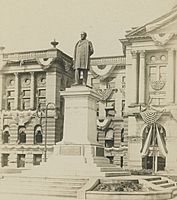
McKinley Monument in front of Lucas County Courthouse, Toledo, Ohio.
.jpg)


_(cropped).jpg)


See also
 In Spanish: William McKinley para niños
